
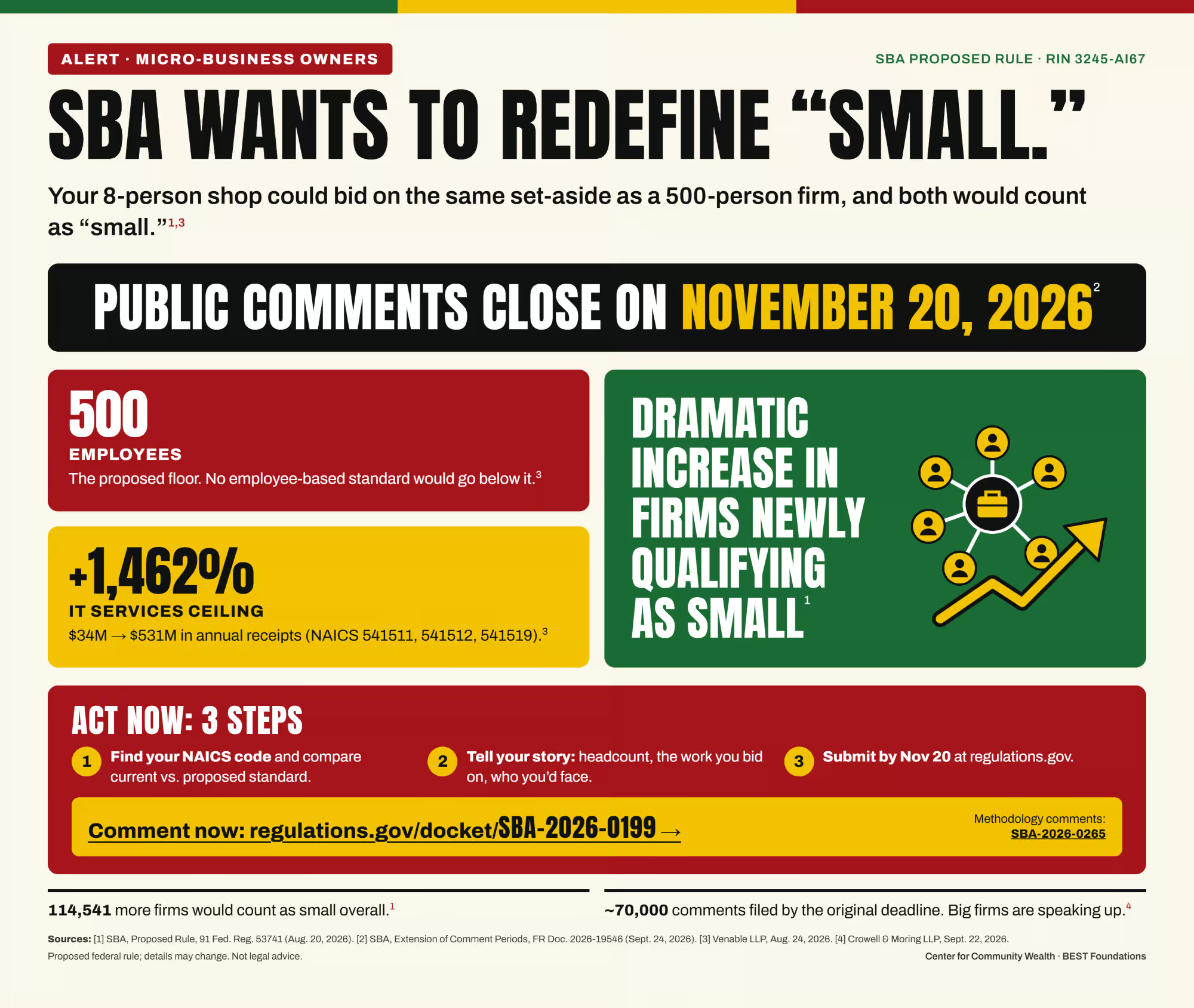
The SBA issues a seismic proposed change to “small” business definition and micro-businesses need to comment on the impact
October 1, 2026
•
Kimberly Bonner
If you run a business with fewer than ten people, please pay close attention.
Why "small" status matters
The U.S. Small Business Administration (SBA) sets size standards that decide how big a company can be and still count as "small."1 That label is your way into small business set-aside contracts. It also decides who can get SBA-backed loans and guarantees. In SBA's own words, firms without small status lose access to SBA-backed capital, which limits what they can invest in equipment, technology and their workforce. They also lose benefits such as lower taxes and exemptions from certain compliance and paperwork requirements.2
So when SBA changes the definition of small, every micro-business owner should pay very close attention. SBA doesn't formally recognize "micro-businesses" in its size rules, but its Office of Advocacy has generally described them as firms with 1 to 9 employees.3
That describes most of the business owners I work with every day.
What SBA proposed
On August 20, 2026, SBA published one of the biggest changes to the definition of small business in decades. The proposal would:
- Collapse nearly 1,000 industry size standards into 338.2
- Make employee count, not revenue, the default way to measure size.2
- Raise thresholds across the board, in some industries by more than 1,000%.4
- Set the lowest employee-based standard at 500 employees.5
Some of the jumps are hard to believe. And are almost breathtakingly stunning to review.
For IT and computer services (NAICS 541511, 541512 and 541519), the ceiling would go from $34 million in annual receipts to $531 million, an increase of 1,462%. Management consulting would rise 1,104%. Architectural services would rise 980%.4
Construction hits close to home for me. Most residential and specialty trade construction industries would move from receipts standards in the $15 million to $45 million range to headcount standards of 550 to 650 employees. Electrical contractors, for example, would have a 550-employee standard. 6, 7
Picture an eight-person electrical shop bidding on a small business set-aside. Under this proposal, a company with 500 employees could compete for that same award, and both would be "small."
None of these larger firms are doing anything wrong by qualifying. The rule simply moves the line so high that "small" stops meaning what most of us think it means.This rule change defies our lived experience and the reality of what “small” business truly means.
The numbers keep changing
When SBA released the rule, it estimated that about 114,541 more businesses would count as small. That included 37,002 firms that already hold federal contracts worth more than $71 billion.2
A few weeks later, SBA's Office of Advocacy released its own analysis. It found that only 4,000 to 6,000 current contractors would gain small business status, and it described the rule as a narrow, targeted adjustment rather than a broad expansion.8, 9 Advocacy was comparing its number to SBA's estimate of 37,002 contractors, not the full 114,541.9
Either way, the gap is huge. When two offices inside the same agency can't agree on who this rule affects, the public deserves to know why.
What this means for micro-businesses
To be clear, micro-businesses (under 10 employees) and small businesses with 10 to 49 employees would not lose their own small status under this proposal. The risk is dilution.
You would hold a smaller share of a bigger pool, competing against firms with full legal and business development teams, in the very set-asides that were created to reach businesses like yours. SBA's own analysis argues that newly eligible firms will mostly compete with businesses close to the size limit, not with the smallest firms.2
Maybe that holds in some industries. In the trades, I'm not so sure, and the people who can say for certain are the owners bidding on these jobs. That is exactly the kind of firsthand evidence SBA needs to hear.
Through the BEST program, I work with historically underutilized businesses (HUBs) in the skilled trades. Many of them are small firms with tight capital and limited bonding capacity. They will feel this competitive pressure first, while most of the room to grow under this rule goes to firms that already have scale.
The deadline was extended. Use the time.
Comments were first due September 21, 2026. After small businesses and industry groups said 30 days was not enough time to understand a rule this big, SBA extended the deadline to November 20, 2026.10 By the original deadline, SBA had already received nearly 70,000 comments, and it even held an in-person town hall right here in Denver.9, 11
SBA must consider public comments and respond to the significant issues they raise before it can finalize this rule. Micro-business owners are rarely heard in these processes. That isn't because the rule doesn't affect them. It's because nobody told them the door was open.
Consider this your notice.
What to do before November 20
- Find your NAICS code and compare your current size standard with the proposed one. The full proposed table is in the Federal Register.2
- Submit a comment at Regulations.gov under Docket SBA-2026-0199.12 Use your own words and your own numbers. Tell SBA how many people you employ, what kind of work you bid on, and who you would be competing against under the new standard. You can also comment on the methodology behind the rule under Docket SBA-2026-0265.13
- Share this article with every micro-business owner you know. The comment period is public, but most owners don't know it exists. We can close that gap together before the deadline.
A simple way to start your comment
My name is [your name], and I own [business name], a [trade or industry] business in [city, state] with [number] employees. My primary NAICS code is [code]. Today, the size standard for my industry is [current standard].
Under the proposed standard of [proposed standard], I would compete for the same set-aside contracts as much larger firms. For a business my size, that means [your specific impact, such as lost bids, bonding limits or pricing pressure]. I ask SBA to [your request].
Silence is not a strategy
This rule isn't final, and it can still change. What is certain is the date: comments are due November 20, 2026. Staying silent is the one guaranteed way to leave this rule exactly as it is written. For micro-business owners, that would be devastating.
Kimberly Marie Bonner
Small Business Development Manager, Center for Community Wealth (CCW)
Leader, Building with Entrepreneurs in Skilled Trades (BEST) Foundations Cohort Program
Explore BEST program resources | kimberly@communitywealth.org
Watch recent podcast featuring Kimberly Bonner: Center for Community Wealth
This article is for general information and is not legal advice. Figures reflect a proposed federal rule that may change before it is finalized.
Notes
- U.S. Small Business Administration, "Size Standards," https://www.sba.gov/federal-contracting/contracting-guide/size-standards.
- U.S. Small Business Administration, "Small Business Size Standards," Proposed Rule, 91 Fed. Reg. 53741 (Aug. 20, 2026), RIN 3245-AI67, https://www.federalregister.gov/documents/2026/08/20/2026-17042/small-business-size-standards. Full size standards table: https://www.govinfo.gov/content/pkg/FR-2026-08-20/pdf/2026-17042.pdf.
- U.S. Small Business Administration, Office of Advocacy, "The Role of Microbusiness Employers in the Economy," Aug. 1, 2017, https://advocacy.sba.gov/2017/08/01/the-role-of-microbusiness-employers-in-the-economy/.
- Venable LLP, "SBA Proposes Significant Expansion of Small Business Size Standards," Aug. 2026, https://www.venable.com/insights/publications/2026/08/sba-proposes-significant-expansion-of-small
- Greenberg Traurig LLP, "SBA Proposes Major Changes to Small Business Methodology and Size Standards," Aug. 2026, https://www.gtlaw.com/ar/insights/2026/8/sba-proposes-major-changes-to-small-business-methodology-and-size-standards.
- Independent Electrical Contractors, member update on SBA's proposed size standards for NAICS 23821, 2026, https://ieci.org/?p=20546.
- Sidley Austin LLP, "SBA Proposes to Rewrite the Size Standards: Fewer Standards, Higher Thresholds, and a Shift," Government Contracts Update, Sept. 2026, https://www.sidley.com/en/insights/newsupdates/2026/09/sba-proposes-to-rewrite-the-size-standards-fewer-standards-higher-thresholds-and-a-shift.
- Washington Technology, "SBA Reopens Size Standard Comment Period, Slashes Estimates of Its Impacts," Sept. 2026, https://www.washingtontechnology.com/contracts/2026/09/sba-reopens-size-standard-comment-period-slashes-estimates-its-impacts/416136/.
- Baker Donelson, "SBA Proposes Major Overhaul of Small Business Size Standards: What Businesses, Government Contractors, and Investors Need to Know," 2026, https://www.bakerdonelson.com/sba-proposes-major-overhaul-of-small-business-size-standards-what-businesses-government-contractors-and-investors-need-to-know.
- U.S. Small Business Administration, "Small Business Size Standards," Extension of Comment Periods, Federal Register (Sept. 24, 2026), FR Doc. 2026-19546, https://www.federalregister.gov/d/2026-19546.
- Crowell & Moring LLP, "SBA Extends Deadline for Comments on Historic Overhaul of Size Standards," Sept. 22, 2026, https://www.crowell.com/en/insights/client-alerts/sba-extends-deadline-for-comments-on-historic-overhaul-of-size-standards.
- Regulations.gov, Docket SBA-2026-0199, Small Business Size Standards, https://www.regulations.gov/docket/SBA-2026-0199.
- Clark Hill PLC, "SBA Extends Comment Period for Proposed Size-Standards Overhaul," 2026, https://www.clarkhill.com/news-events/news/sba-extends-comment-period-small-business-size-standards/.




You May Also Like:



Donate
Make a donation to the Center for Community Wealth!